Advanced Glacier2 Client Configurations
3 min read
3 min read
3 min read
3 min read
3 min read
3 min read
3 min read
3 min read
3 min read
This section details strategies that Glacier2 clients can use to address more advanced requirements.
Callback Strategies with Multiple Object Adapters
An application that receives callback requests through a router and also services requests from local clients uses two object adapters. For example, suppose we have the network configuration shown in the following illustration:
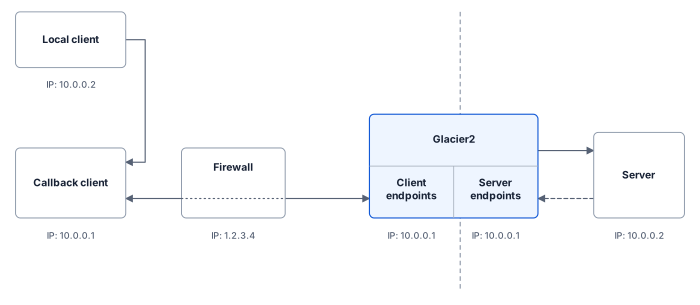
An object adapter configured with a router has no endpoints of its own: its published endpoints are the published endpoints of the router's server object adapter, Glacier2.Server, so the proxies it creates contain these endpoints. The callback client therefore dedicates one object adapter, configured with the router proxy, to callback requests, and a second object adapter, with local endpoints, to requests from local clients.
Using Multiple Routers
A client is not limited to using only one router at a time: the proxy methodproxy methodproxy methodproxy methodproxy methodproxy methodproxy methodproxy method ice_router allows a client to configure its routed proxies as necessary. With respect to callbacks, a client must create a new callback object adapter for each router that can forward callback requests to the client. A client must also be aware of the object identities in use by the routers.
Using the RouterFinder Interface
RouterFinder InterfaceYou may know the endpoints of a Glacier2 router but not its identity, since a router can be configured with a non-default identity through Glacier2.InstanceName. In this situation, create a proxy with the identity Ice/RouterFinder and the router's endpoints, for example Ice/RouterFinder:tcp -h prodhost -p 4063, and call getRouter on this proxy. The router finder returns a proxy to the Glacier2 router.